Varanasi cricket stadium is one of the most anticipated cricket infrastructure projects in Uttar Pradesh. Officially planned as the Varanasi International Cricket Stadium, the venue is being developed in the Rajatalab area near Ring Road Phase-2. With a planned seating capacity of 30,000 spectators, expandable to 40,000, the stadium is expected to give Varanasi a major international-level sporting venue.
What makes the project especially interesting is that it is not designed as an ordinary modern cricket ground. Its architecture draws inspiration from Varanasi’s spiritual identity and Lord Shiva, with features such as Trishul-shaped floodlights, a Damru-inspired pavilion and a crescent-shaped roofline. The project combines cricket, modern infrastructure and local culture in a way that could make it one of India’s most distinctive stadiums.
Varanasi Cricket Stadium – Quick Overview
The Varanasi cricket stadium is being developed on approximately 30 acres of land in the Rajatalab area of Varanasi. The Uttar Pradesh government acquired the land for around ₹121 crore, while the estimated construction cost is approximately ₹330 crore. Larsen & Toubro (L&T) was awarded the project, which is being developed under a 30-year public-private partnership model.
The stadium is expected to accommodate 30,000 spectators initially, with provisions for expansion to around 40,000. It will include international and domestic cricket pitches, practice facilities, modern drainage, hospitality areas, parking and broadcasting infrastructure. The project is supported by the BCCI, UPCA and Government of Uttar Pradesh, giving it an important place in the state’s cricketing infrastructure.
| Category | Details |
| Official Name | Varanasi International Cricket Stadium |
| Location | Rajatalab, Varanasi, Uttar Pradesh |
| Nearby Road | Ring Road Phase-2 |
| Land Area | Around 30 acres |
| Initial Capacity | 30,000 spectators |
| Expandable Capacity | Up to 40,000 |
| Land Cost | Around ₹121 crore |
| Construction Cost | Around ₹330 crore |
| Builder | Larsen & Toubro (L&T) |
| Operating Model | 30-year Public-Private Partnership |
| Pitches | 18 |
| Practice Wickets | 9 |
| Outdoor Practice Ground | 1 |
| Expected Opening | 2026 |
Read Also: Eden Gardens Stadium || Kalinga Stadium
Why Varanasi? The City Behind the Stadium
Varanasi, also known as Kashi and Benares, is one of India’s oldest continuously inhabited cities. Located on the banks of the Ganges, the city is famous for its ghats, temples, music, traditions and spiritual importance. It is also a major tourist destination, attracting visitors from across India and around the world. Building a modern cricket stadium here gives the city another identity alongside its historic and cultural significance. Cricket already enjoys enormous popularity throughout Uttar Pradesh, and Varanasi has a passionate local fan base. The arrival of an international-standard stadium can provide a stronger platform for players from eastern Uttar Pradesh while giving local spectators an opportunity to watch high-level cricket closer to home.
A future international match in Varanasi could also combine sporting excitement with the city’s unique cultural atmosphere. The location also makes sense from a regional perspective. Uttar Pradesh already has established cricket venues, but a major stadium in Varanasi can expand the state’s cricketing footprint toward the eastern part of the state. In the long term, the venue could become useful for domestic competitions, international fixtures and potentially major tournaments, subject to the necessary approvals and scheduling.
How It Started – The Origin Story of the Project
The Varanasi cricket stadium project was formally announced in April 2023 when the Uttar Pradesh government confirmed plans to develop an international cricket stadium in the city. The project was conceived as part of the broader effort to expand high-quality cricket infrastructure beyond India’s traditional major sporting centres. Larsen & Toubro won the tender for the project in August 2023. The company was selected to undertake the major construction and development work, bringing experience in large infrastructure projects.
The Uttar Pradesh government subsequently acquired around 30 acres near Ring Road Phase-2 in Rajatalab for the development. A major ceremony connected with the project was held on September 23, 2023. The development has received institutional backing from the BCCI, Uttar Pradesh Cricket Association and the Uttar Pradesh government. The operating structure is based on a 30-year public-private partnership, with L&T involved in the design, construction and operational aspects of the venue.
Key milestones include:
- Project formally announced in April 2023.
- L&T awarded the construction contract in August 2023.
- Around 30 acres acquired in Rajatalab.
- Major project ceremony held on September 23, 2023.
- Construction progressed substantially through 2024 and 2025.
- Around three-fourths of the work was reported as complete by late 2025.
- Operational opening has been targeted for 2026.
Images of Varanasi Cricket Stadium
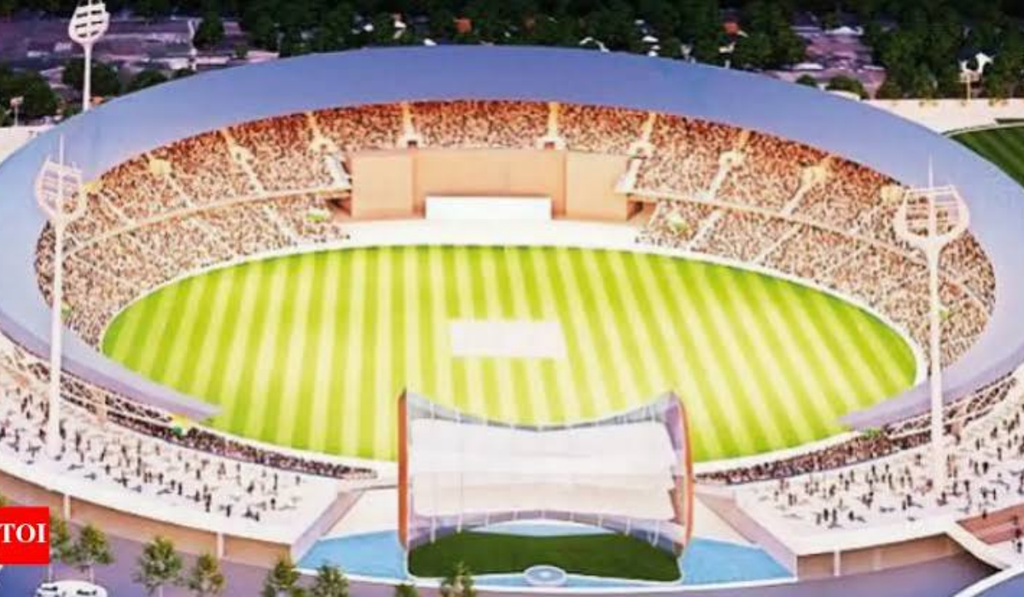
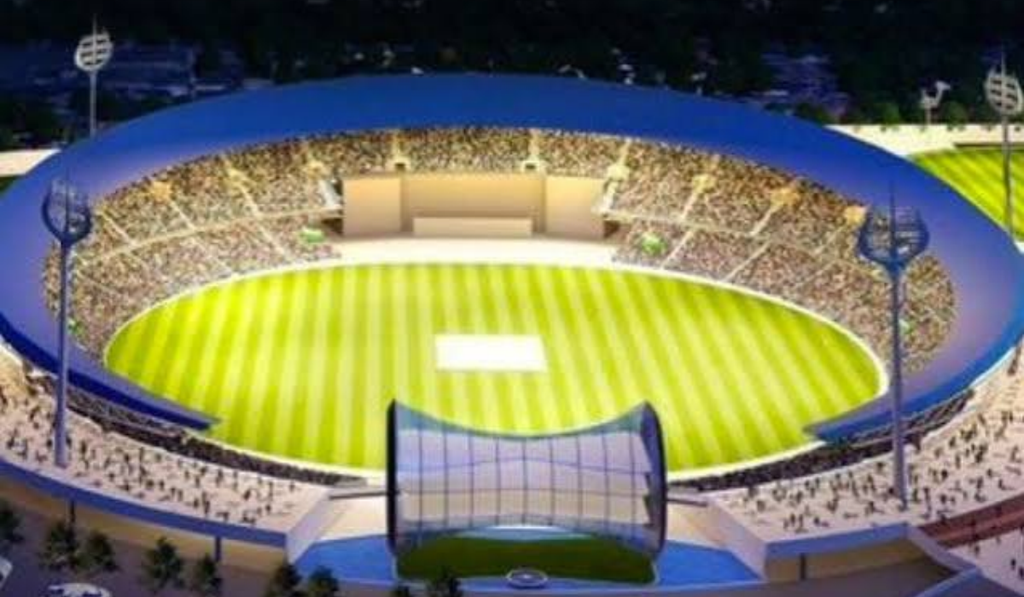
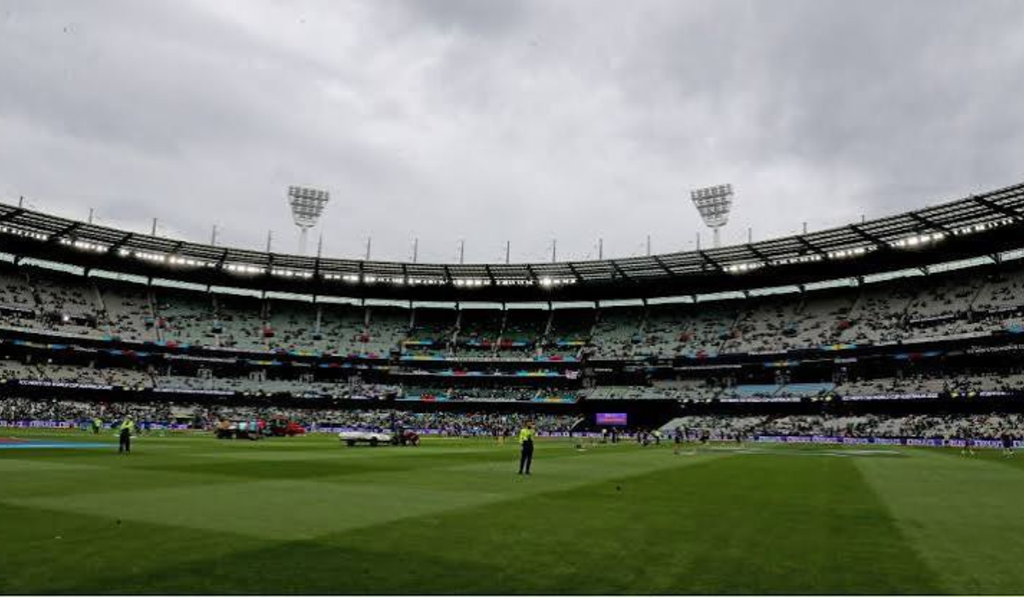
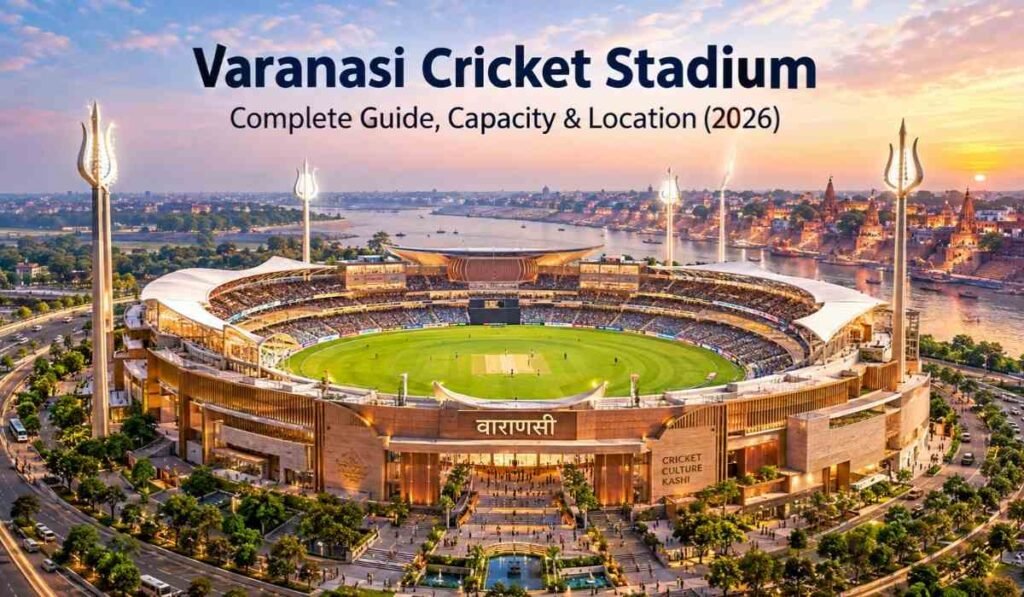
The proposed Varanasi cricket stadium stands out visually because its design goes beyond the conventional circular or oval cricket-ground appearance. Concept images and construction visuals show a venue designed around cultural references associated with Varanasi and Lord Shiva. The stadium’s architectural identity is therefore expected to be an important part of its appeal when the venue becomes operational.
Among the most recognizable visual elements are the Trishul-inspired floodlight towers. The design also incorporates a Damru-shaped pavilion and a crescent-like roofline. Together, these elements are intended to connect the modern sporting complex with the religious and cultural character of Kashi.
For an article gallery, images can focus on the following aspects:
- Exterior view and overall stadium structure
- Trishul-shaped floodlight towers
- Damru-inspired pavilion
- Crescent-shaped roof design
- Seating bowl and spectator areas
- Main cricket field
- Construction progress
- Stadium approach roads and surrounding infrastructure
Passion Meets Sports: Design and Architecture
The architecture is arguably the most talked-about aspect of the Varanasi cricket stadium. Instead of creating a generic modern sports venue, the designers have incorporated visual elements associated with Lord Shiva and Varanasi. This approach allows the stadium to have a recognizable identity that is directly connected to the city in which it is being built. The Trishul-shaped floodlights are among the project’s most distinctive features. Their form represents the Trishul, one of the major symbols associated with Lord Shiva. The pavilion is inspired by the Damru, while the roofline takes inspiration from the crescent moon traditionally associated with Shiva.
These details give the stadium an architectural character that reflects the heritage of Kashi. The design also draws inspiration from the ghats of Varanasi. The city’s stepped ghats are an important part of its visual identity, and their influence can be seen in the broader architectural concept. As a result, the stadium is intended to feel connected to Varanasi rather than appearing as an unrelated structure placed within the city.
Important design elements include:
- Trishul-shaped floodlight towers
- Damru-inspired pavilion
- Crescent-shaped roofline
- Architectural references to Varanasi’s ghats
- Modern spectator facilities
- International-standard cricket infrastructure
- A design intended to combine tradition with contemporary construction
Facilities and Infrastructure
The Varanasi cricket stadium is planned as a modern cricket facility capable of hosting both domestic and international matches. The venue is expected to have a seating capacity of 30,000, with the possibility of increasing capacity to approximately 40,000 as future requirements grow. This makes it large enough to accommodate significant crowds while leaving room for expansion.
The project includes a substantial cricketing infrastructure. According to the available project details, the stadium will have 18 pitches for international and domestic requirements, along with nine practice wickets around the main ground and a separate outdoor practice ground. An advanced drainage system is also planned to help the playing surface recover more efficiently following heavy rainfall.
Other planned facilities include:
| Facility | Planned Provision |
| Seating | 30,000, expandable to 40,000 |
| Cricket Pitches | 18 |
| Practice Wickets | 9 |
| Outdoor Practice Ground | 1 |
| Drainage | Advanced drainage system |
| Hospitality | VVIP and VIP areas |
| Parking | Dedicated parking facilities |
| Broadcasting | Modern broadcast facilities |
| Access | Improved approach roads |
| Public Transport | Planned match-day improvements |
The stadium’s infrastructure is also designed with large events in mind. VIP and VVIP areas, hospitality facilities, parking and broadcasting infrastructure are intended to support high-profile fixtures. Improvements around Ring Road Phase-2 are also expected to help manage traffic and spectator movement when the stadium begins hosting matches.
Construction Timeline and Current Status
Construction of the Varanasi cricket stadium has progressed significantly, although the project has experienced delays. By late 2025, approximately 75% of the work had reportedly been completed, with major structural components and stands already taking shape. Some of the stadium’s signature features, including the distinctive Trishul-shaped floodlights, were also visible during the construction phase.
Weather conditions and the complexity of large-scale construction contributed to changes in the original schedule. The prolonged 2024 monsoon season was cited among the factors affecting progress. Earlier expectations pointed toward completion around May 2026, while later updates indicated that full operational status could move toward the middle or latter part of 2026.
A simplified timeline of the project is:
- April 2023 – International cricket stadium project announced.
- August 2023 – L&T awarded the project.
- September 23, 2023 – Major project ceremony held.
- 2024 – Construction continued amid weather-related challenges.
- Late 2025 – Approximately 75% of the project reported complete.
- 2026 – Target period for completion and opening.
Since construction schedules can change, the actual opening date and first official fixture should be confirmed through announcements from the relevant cricket authorities before planning a visit.
Location: Varanasi Cricket Stadium
The Varanasi cricket stadium is located in the Rajatalab area of Varanasi, Uttar Pradesh, beside Ring Road Phase-2. The site was selected on approximately 30 acres of land acquired by the Uttar Pradesh government. Its position on the outskirts of the city provides space for a large modern sporting complex while allowing connections to major road infrastructure.
The location is particularly significant because a stadium designed for crowds of tens of thousands requires more than just a large playing field. Roads, parking, public transport and crowd-management systems all need to work together. Planned improvements around the approach roads and transport services are therefore an important part of making the stadium practical for major match days.
| Location Detail | Information |
| City | Varanasi |
| State | Uttar Pradesh |
| Area | Rajatalab |
| Nearby Infrastructure | Ring Road Phase-2 |
| Land Area | Around 30 acres |
| Coordinates | 25°17′45″N 82°51′18″E |
For visitors coming to Varanasi, the stadium could eventually become another major attraction alongside the city’s historic ghats, temples and other landmarks. However, travel arrangements should be planned according to the final road access, public transport availability and official stadium opening information.
Projected First Matches and Beyond
As of the available 2026 information, an official fixture list for the stadium had not been released. This means it is too early to state with certainty which team will play the first match or when the first international fixture will take place. The most logical early use of the venue could involve domestic cricket. Ranji Trophy matches and other Uttar Pradesh fixtures would give the ground management team an opportunity to assess the pitch, drainage, spectator facilities, security systems and match-day operations before larger international events are hosted.
Over time, the stadium could potentially become a venue for:
- Ranji Trophy matches
- Domestic limited-overs cricket
- India bilateral ODI matches
- India T20I matches
- Women’s international cricket
- IPL-related fixtures, subject to scheduling
- Major domestic tournaments
- Potential future ICC events, subject to selection and approval
The combination of a 30,000-seat capacity, modern facilities and a distinctive architectural identity gives the venue considerable potential. However, hosting an ICC event or international fixture ultimately depends on sporting requirements, official approvals, scheduling decisions and the stadium meeting all relevant standards.
Frequently Asked Questions (FAQs)
Q1. What is the capacity of Varanasi cricket stadium?
The Varanasi cricket stadium is planned to accommodate around 30,000 spectators, with provisions to expand the capacity to nearly 40,000 in the future. This large seating capacity will make it suitable for domestic and potentially international cricket matches. The final use will depend on official approvals and scheduling.
Q2. Who is behind the Varanasi cricket stadium?
The project is being developed with the support of the Government of Uttar Pradesh, BCCI and Uttar Pradesh Cricket Association. Larsen & Toubro was awarded the construction project in August 2023 under a 30-year public-private partnership model. The company is involved in the design, construction and operation of the stadium.
Q3. What makes the unique architecture of Varanasi cricket stadium?
The architecture of the Varanasi cricket stadium is inspired by Varanasi’s cultural and spiritual heritage. Its design includes Trishul-shaped floodlights, a Damru-inspired pavilion and a crescent-shaped roofline associated with Lord Shiva. References to the city’s famous ghats further give the stadium a distinctive identity.
Q4. What should be the number of pitches in Varanasi cricket stadium?
The Varanasi cricket stadium is planned with 18 cricket pitches for domestic and international requirements. It will also feature nine practice wickets and a separate outdoor practice ground. These facilities are expected to provide professional teams with sufficient space for training and match preparation.
Q5. How much does the Varanasi cricket stadium project cost?
The estimated project investment is around ₹450 crore, including approximately ₹121 crore spent on land acquisition and about ₹330 crore for construction. The investment covers the stadium, practice facilities, spectator areas, hospitality, parking, drainage and broadcasting infrastructure. The final cost may change as the project progresses.
Conclusion
The Varanasi cricket stadium represents much more than the construction of another cricket ground in Uttar Pradesh. It is an attempt to create a modern sporting venue that reflects the character of one of India’s most historic cities. With a planned capacity of 30,000 spectators, expandable to 40,000, the stadium has the scale required for major domestic and potentially international cricket. Its strongest point may be the way sport and culture have been brought together. The Trishul-shaped floodlights, Damru-inspired pavilion and crescent roofline give the venue a visual identity closely connected with Varanasi.
Once completed, the stadium could become an important sporting landmark for eastern Uttar Pradesh and a memorable destination for cricket fans. The project has already attracted considerable attention because of its size, design and location. If construction and operational preparations proceed as planned, Varanasi could soon have a cricket venue capable of hosting major matches while carrying the unmistakable visual character of Kashi.
Read Also: Gaddafi Stadium || JLN Stadium